Most Popular Posts of 2006 (Belated Edition)

Okay, so I finally got around to reviewing 2006 stats for Global by Design. My goal is to install a real-time “most popular” sidebar; until then, here are the most popular entries:

Baidu vs. Google: Round Two

The World According to Wikipedia

Just Don’t Do It: The Art of Slogan Translation

China and Japan: So Close But Yet So Far

McDonald’s Scores with “McRice Burger”

And although this entry is quite new, it’s been very active:

Statistical Machine Translation Gets Real: A Profile of Language Weaver

Our guest articles have also been very well read. Here are the top three:

Scaling a Great Wall: Top 5 Tips for Learning Chinese

Just How Literal Do You Want That Translation?

The Good, The Bad and The Ugly

Finally, in the completely unrelated category, the most popular entry is my post from Punta Tombo:

Greetings from Punta Tombo!

Must be all those cute penguin photos!

Wikipedia vs. Google

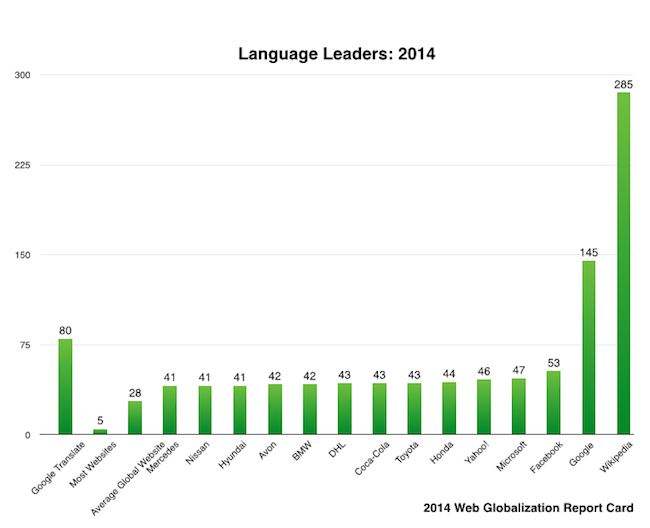
In our 2006 Web Globalization Report Card, the top two global Web sites overall were Google and Wikipedia. Both organizations support more than 100 languages and a fast-loading, flexible global design template.Which is why I was interested to read that Jimmy Wales, the Wikipedia founder, is planning to develop a Wiki-based search engine. Of course, this is much easier said than done. Wikipedia required a huge network of devoted volunteers to become something of value. Would a similar group of people coalesce around a search engine?

search_wikia.gif

This will be very interesting to watch. Jimmy writes that search engines are broken “for the same reason that proprietary software is always broken: lack of freedom, lack of community, lack of accountability, lack of transparency.”

I do think that search engines in general have lost a great deal of quality over the past year as businesses have figured out how to optimize their rankings at the expense of actually providing content that the user actually is looking for.

Why Is Web Globalization So Popular? Just Look at the Numbers…

I was happy to see a press release from comScore Networks illustrating in raw numbers what many Webmasters have been telling me privately over the years — that more than half of their Web traffic is coming from outside of the US.

The comScore study found that “14 of the top 25 U.S. Web properties attract more traffic from people outside the U.S. than from within.”

What comScore did was look at total traffic numbers for these Web sites and then split out US-only visitors to get at the percentage of non-US visitors.

Which sites have the most non-US visitors?

Google and Wikipedia

Roughly 80% of their visitors live outside the US, a percentage that will only increase in the years ahead.

This trend is a major reason why multinationals have been investing heavily in Web localization. That’s where all the growth is.

And it’s not sheer coincidence that the top two ranked global Web sites in our 2006 Web Globalization Report Card also happen to be Google and Wikepedia. These two properties came out on top because they have done the most to attract a global audience. Both Google and Wikipedia support more than a hundred languages and offer a wealth of localized content within those languages.

Will companies like Nike and Starbucks one day support more than a hundred languages on their Web sites?

Possibly.

Forty languages?

Absolutely. It’s just a matter of time — and a matter of numbers.

I’ll leave you with a parting quote from comScore:

“As Internet usage outside the U.S. has grown rapidly from a small base, the U.S. share of the world’s online population has fallen from 65 percent to less than 25 percent in the last 10 years,” said Bob Ivins, managing director of comScore Europe. “The fact that more than three-quarters of the traffic to Google, Yahoo!, and Microsoft is now coming from outside of the U.S. is indicative of what a truly global medium the Internet has become.”

The World According to Wikipedia

Note: This post is excerpted from the September issue of the Global By Design newsletter.

Earlier this year, we published the third edition of The Web Globalization Report Card, our annual benchmarking of many of the world’s leading corporate Web sites.
Wikipedia logo - french

For 2006, we expanded our focus to include a number of government and non-profit Web sites, including Wikipedia. We suspected that Wikipedia would score well given its global reach, but we were quite surprised to find it scoring a 93 out of 100, second only to Google, which scored 97.

How did Wikipedia, with a budget of less than half a million dollars, develop a global Web site that scored better in our tests than a host of billion-dollar multinational corporations?

A global network of volunteers, for starters.

But the more we studied Wikipedia — and interviewed the interim executive director Brad Patrick — the more we realized that there were some valuable lessons here that any company could benefit from.
Leading with Language

The home page of Wikipedia is dominated by language links; the languages that support the largest number of articles are most prominent. Wikipedia uses Unicode as the default Web page encoding so that all languages may be displayed in their native script — essential to improving usability. Given the large number of scripts that Wikipedia supports, your browser may display some language names as a series of questions marks or empty boxes — a sign that your computer does not have the required font.

Wikipedia Home

Language –in form of the two-digit language codes — also forms the foundation for the architecture of the Web site. As shown below, the URLs for the “apple” entry from the English and German Wikipedias vary only by language code:

• http://en.wikipedia.org/wiki/Apple
• http://de.wikipedia.org/wiki/Apple

With a design that is utilitarian in nature, the content becomes king. And it is the content that makes Wikipedia so popular

According to Alexa (www.alexa.com), Wikipedia is the sixteenth most popular global Web site. But the site is even more popular in countries such as Germany and Canada. According to Alexa, here is Wikipedia’s popularity ranking within specific countries:

Country –> Rank
Argentina –> 19
Brazil –> 24
Canada –> 8
Egypt –> 64
France –> 11
Germany –> 6
India –> 16
Japan –> 18
Russia –> 39
US –> 9

There is a rough correlation between depth of content and popularity within a given market.
Q&A With Brad Patrick

Brad Patrick is the interim executive director and general counsel for Wikipedia. We recently spoke with Brad to better understand how Wikipedia works and where it is headed.

Q: Do your non-English Wikipedias consist of original content or content that has been translated from other languages?
A: Both. Our sites are hybrids of original and translated content. It depends upon people’ interests. For example, our Polish wiki features a great deal of original content because of a group of dedicated contributors.

Q: So the amount of content within each language is completely dictated by contributors?
A: Yes. You’re going to see different degrees of content by language. We are not going to orchestrate one size fits all. Even the press releases for the Wikipedia Foundation are handled this way. They are translated into languages according to the willingness of contributors to do so.

Q: What percentage of your traffic is directed toward English-language content?
A: Roughly 60%, and falling.

Q: What has been key to the success of Wikipedia?
A: You have to trust your community. We’re not telling this mass of people what to do. You have to listen to them. This is not a top-down effort but a collaborative effort.

Q: How is Wikipedia supported financially?
A: We have a very strong donor base. Periodically, we conduct fundraising drives; we raised $400,000 in four weeks last year. We are not a membership organization and do not have plans to become one. We are interested in developing institutional support.

Web Globalization Lessons from Wikipedia

What can a global Web services manager learn from Wikipedia? We have identified four attributes of Wikipedia that we believe have relevance even to large multinationals.

1. Keep Content Close to the User
If there is one takeaway from Wikipedia, it is in the power of letting go. Or, in corporate-speak, decentralization.

Because Wikipedia was built from the ground up to rely on its content contributors, it relinquished a high degree of control over content from the start. Content stays close to the user because it is written or translated by the very people who consume the content.

While we do not necessarily advocate turning over the content reins to your customers, we do believe that local employees and partners can and should play an active role in content creation and management. They are generally more in touch with current events in the subtleties of their countries and cultures.

As large companies strive to centralize tools and content, they need to do so gently and tactfully, so as not to dampen the enthusiasm of the local content creators, reviewers, and managers.

The people who create Wikipedia content are a passionate bunch. There are similarly passionate people within large corporations — and it is these types of people who can be ideal for taking a lead role at the local level. The key is in identifying them and giving them the room they need to flourish. It’s all about finding the right balance between chaos and control. Wikipedia seems to have found its balance, and companies can do the same thing.

For the complete article, The World According to Wikipedia, consider becoming a Global By Design subscriber.