The Top 25 Global Web Sites of 2011

I’m pleased to announce the publication of the 2011 Web Globalization Report Card. This year, we reviewed 250 web sites across 25 industries. The web sites represent nearly half of the Fortune 100 and nearly all of the Interbrand Global 100.

Out of these 250 sites, here are the top 25 overall:

Google, which has held the number one spot for years, was unseated by Facebook this year. Facebook’s recent innovations (multilingual social plugins, improved global gateway, multilingual user profiles) gave it the edge. (I’ve devoted a separate report to Facebook’s innovations.)

Companies like 3M, Cisco, Philips, and NIVEA have become regular faces in the top 25. But there are some new faces as well. There are five companies new this year to the top 25: Volkswagen, Adobe, Shell, Skype, and DHL.

Although these 25 web sites represent a wide range of industries, they all share a high degree of global consistency and impressive support for languages. They average 58 languages — which is more than twice the average for all 250 sites reviewed.

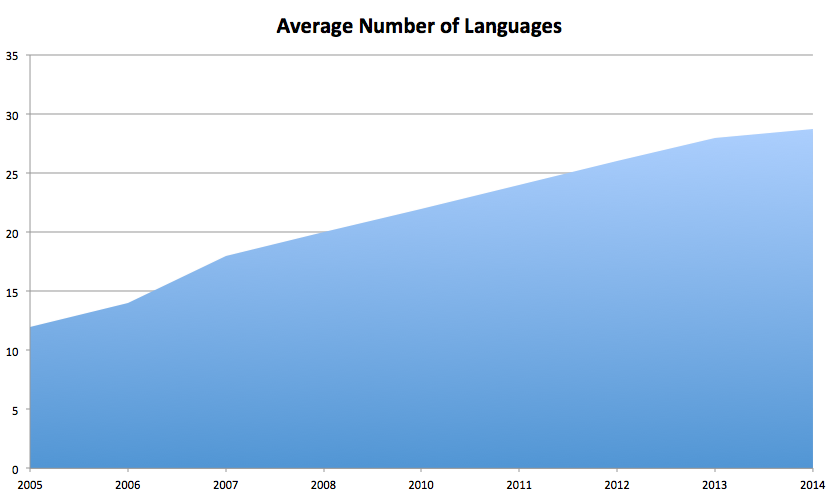
The average number of languages supported by  all 250 web sites is 23, up from 22 last year. As the visual below illustrates, language growth over the years has been amazing. Seven years ago, I was thrilled to find a web site with more than 20 languages. Today, 20 languages is below average.

Language is just one element of web globalization, but it is the most visible element. When a company adds a language, it is making its global expansion plans known. If you want to know where your competitors are betting on growth, spend some time looking at their local web sites. More than twenty companies added four or more languages over the past 12 months.

Fast-growing languages on the Internet include Hungarian, Turkish, Indonesian, and Russian. Here is where Russian stands today — now found on nearly 8 of 10 web sites:

In the Report Card, languages account for 25% of a web site’s score. We also evaluate a web site’s depth and breadth of local content, the effectiveness of the global gateway, and overall global consistency. Beginning in 2010, we have also begun tracking how companies promote local social platforms such as Facebook and Twitter around the world. Our goal was not only to highlight the leaders in language but to identify those web sites and services that were globally “well rounded” as well as innovative.

The top 25 web sites are not perfect. The Report Card details many ways these sites could be improved (including Facebook and Google). That said, the executives who manage these web sites and services deserve a great deal of credit. As someone who has worked as both a consultant and an employee at companies such as these, I know how challenging it can be to get the funding to add languages and staff and to educate various teams on the many complexities of web globalization. While it may be the company names that appear on the top 25 list, it is the hundreds of passionate and bright people who got them there.

Congratulations!

Is Facebook “translation worthy” or just plain cheap?

I read at Design Across Cultures that Facebook is planning to use “crowdsourcing” to allow its users to create translated content.

Crowdsourcing is a hot new buzzword that is best illustrated by Wikipedia — you take a lot of motivated volunteers, give them access to your Web site, and let them go crazy. I’m simplifying things of course, and crowdsourcing is no cure-all. People sometimes game the system for various reasons. But the net result can amount to something that could never have been created without the crowd involvement.

Now, Wikipedia has next to no money and it’s a non-profit; crowdsourcing is not just a great strategy but a necessity.

And crowdsourcing can be a great way to localize your Web site.

Google relied on crowdsourcing in its early years to translate its search engine interface into more than 60 languages (and still relies on the technique in more limited ways today). Netvibes relied on volunteer translators to quickly localize its interface into more than 60 languages.

Naturally, the idea of having your Web site translated for “free” is alluring to a lot of companies. But very few companies will find that they are translation worthy. Web users will not bother to translate a Web interface if they don’t actually see a need to use the product itself in their native language.

So Is Facebook Translation Worthy?

You can’t fault Facebook for trying to get some free translation help, and I suspect that it will find plenty of volunteer translators, though it will take time. But a part of me can’t help wondering why the company hasn’t just coughed up a few dollars to get its localization efforts moving sooner rather than later. After all, doesn’t the company have a market value of, like, $100 billion?

The challenge with crowdsourcing translations is that nothing is truly free. Facebook has to dedicate people and resources to create the translation workflow and approval processes to ensure that the finished translations are of high quality. These things take time, and time also costs money.

Given the importance of acting quickly when it comes to taking social networking sites global, it seems to me that Facebook would be wise to pay for localization for some core languages and then use crowdsourcing to support the less-strategic languages. This way, Facebook could accelerate tackling those markets that are already seeing Facebook knockoffs (like the Russian knockoff shown below).

Russian facebook

Relying on volunteers to translate content is an emerging trend — one that can give a company a tremendous advantage over its competition. And I think we’ll see many more companies try this strategy in the years ahead.

But before getting started, ask yourself: Is our Web site translation worthy?

UPDATE: Techcrunch provides additional details on Facebook’s translation efforts.

Losing our languages

I often point to Web sites like Google and Wikipedia as great examples of multilingual Web sites.

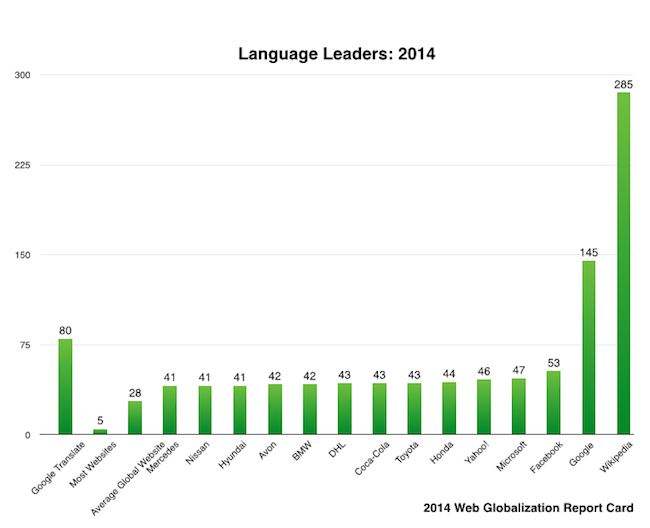
Google supports more than 120 languages and Wikipedia supports more than 150. Few other companies come close to supporting that many languages.

And yet there are thousands of languages in existence on this planet, most of which are not about to be found on Google or Wikipedia anytime soon. Sadly, many of these languages are suffering the fate of those who speak them.

According to the Living Tongues Institute for Endangered Languages:

Minority languages are being increasingly replaced by various politically, economically, or socio-culturally dominant ones. Every two weeks the last fluent speaker of a language passes on and with him/her goes literally hundreds of generations of traditional knowledge encoded in these ancestral tongues. Nearly half of the world’s languages are likely to vanish in the next 100 years.

So where are we losing the most languages? According to this AP article, here are the danger zones:

Language Hotspots

Northern Australia, 153 languages. The researchers said aboriginal Australia holds some of the world’s most endangered languages, in part because aboriginal groups splintered during conflicts with white settlers. Researchers have documented such small language communities as the three known speakers of Magati Ke, the three Yawuru speakers and the lone speaker of Amurdag.

Central South America including Ecuador, Colombia, Peru, Brazil and Bolivia – 113 languages. The area has extremely high diversity, very little documentation and several immediate threats. Small and socially less-valued indigenous languages are being knocked out by Spanish or more dominant indigenous languages in most of the region, and by Portuguese in Brazil.

Northwest Pacific Plateau, including British Columbia in Canada and the states of Washington and Oregon in the U.S., 54 languages. Every language in the American part of this hotspot is endangered or moribund, meaning the youngest speaker is over age 60. An extremely endangered language, with just one speaker, is Siletz Dee-ni, the last of 27 languages once spoken on the Siletz reservation in Oregon.

Eastern Siberian Russia, China, Japan – 23 languages. Government policies in the region have forced speakers of minority languages to use the national and regional languages and, as a result, some have only a few elderly speakers.

Oklahoma, Texas and New Mexico – 40 languages. Oklahoma has one of the highest densities of indigenous languages in the United States. A moribund language of the area is Yuchi, which may be unrelated to any other language in the world. As of 2005, only five elderly members of the Yuchi tribe were fluent.

You can learn more at the Living Tongues Institute for Endangered Languages. They’re doing their best to document these languages before the last speakers have left us.

The Best Global Web Sites (and why)

What separates good global Web sites from great global Web sites? Is it just the number of languages a Web site supports? Certainly languages are essential.

Although every Web site is global by nature, few Web sites support enough languages to be understood by the majority of the world’s Internet users.

But translation is just one aspect of a successful global Web site. As the practice of Web globalization has become mainstream, so too have a number of best practices.

In an effort to identify and understand these established and emerging best practices, in 2003, I began benchmarking the Web sites of hundreds of global companies and organizations. I tracked language use, navigation techniques, and global consistency, and interviewed hundreds of executives who manage these global Web sites. This information formed the basis for The Web Globalization Report Card of which the 2007 edition was recently published.

This article lists the top 10 Web sites from the report and explains some of the best practices that these Web sites have in common.

The Best Global Web Sites
Let’s get right to the top 10 Web sites for 2007:

top_10_global_websites.gif

Google has made itself at home at the top of this list for the past few years. The reason Google excels is not just due to its 115-language search interface. Google has also rapidly localized its many Web-based applications — from Blogger to Adwords — in up to 40 languages.

Wikipedia can lay claim to being the most global Web site on the Internet, offering content in more than 250 languages. Wikipedia proves that you don’t need to be a big corporation to create a wildly successful global Web site; you do, however, need a few thousand very motivated volunteers.

Cisco Systems and Philips both improved their global navigation over the past year, improving their scores. Microsoft recently added a Spanish site for the US market, bringing the number of languages it supports to 40. And American Express supports 29 languages, more than any other financial services company; within the past year, the company added localized sites for Romania and Slovenia.

Although the Web sites on the list reflect a wide range of industries and audience types, you will find they have a number things in common related to Web globalization.

What Makes a Great Global Web Site?
The grading criteria of the The Web Globalization Report Card can be distilled into four best practices:

  1. Languages: To reach 80% of the world’s Internet users, you must support at least 10 languages. The best Web sites support many more.
  2. Localization: Not only is depth of localized content essential to success, but so is the localization of elements such as search engines, promotions, icons, and photos.
  3. Global Navigation: Users must be able to find their local Web sites even if they don’t speak English.
  4. Global Consistency: Global design templates not only support the global brand, they are quite simply a lot easier to manage internally.

Languages: Not Standing Still
It wasn’t very long ago that you could call your Web site global when it supported FIGS (French, Italian, German, Spanish) and Japanese. But rising Internet penetration, the globalization of business, and higher user expectations have given rise to the 30+ language Web site.

While the demand for more languages is hardly surprising, the pace at which many companies are moving is impressive. In the just two years, the following companies have all increased the number of languages they support:

Languages Supported: 2005 to 2007

languages_supported_2005-2007.gif

Based on the Report Card, the average number of languages supported by the 200 Web sites studied is 18 — a 23% increase from 2006. By this time next year the average could very well surpass 20 languages.

Localization: Giving Web Users What They Want
Web localization typically evolves in stages. First, the marketing folks have their way at creating localized Web sites. These mini-sites typically function like brochures — promoting the newest products and services and saying a bit about the company.

The danger with this approach is that the localized Web sites may create the impression that the entire Web sites have been translated, resulting in disappointed users. However, if Web sites are transparent about what they content they support and do not support — the sites have proven to be a positive step forward in Web localization.

Consider Intel’s localized site for France. While a great deal of content is available in French, some content remains in English. Instead of removing the links to the English content, Intel inserts icons to alert the user to English content:

intel_english_content.gif

This is a smart strategy because it gives the user a sense of control and also gives bi-lingual users access to all available information, instead of having to jump back and forth between the US and French Web sites.

Rarely do companies translate all of their content for all markets they serve — the costs are simply too high. The emergence of machine translation will certainly help companies fill in these content gaps, but this too will take time. Until then, a tiered approach to Web localization is the way most companies proceed.

A tiered approach to Web localization aligns resources with potential returns. Managing internal as well as external expectations. It also allows a company to get into a market quickly without risking too much upfront.

Provided the Web site does not create the impression that there is more content beneath the marketing facade, these sites can be successful. Companies may use them to test market demand, generate leads for the local sales team, or simply to appease the local sales offices.

Ultimately, companies will need to spend real money on translating lots of content and localizing the applications that consumers want. And this is where the real work begins.

For example, consider the localized room reservation engine at Starwood Hotels. Shown here, you can see a few details that must be addressed in the localization of this application — such as text expansion from English to German and date formats.

english_german_date_formats.gif

The localization of reservation engines, search engines, shopping carts, and order tracking engines are where the best localized sites distance themselves from the competition.

Truly Global Navigation
Localized Web sites are of little value if the Web user cannot find them. Many global companies find that more than half of the traffic to their .com sites originates from outside of their home market. The challenge then becomes one of directing these Web users to their local sites — something that is easier said than done.

A “select country” pull-down menu on the home page isn’t by itself good enough. Here are the major elements a company may employ to direct Web users to local Web sites:

  • Country domain name (like .fr for France)
  • The splash global gateway
  • The permanent global gateway
  • Language negotiation
  • Geolocation

The splash global gateway and permanent global gateway are illustrated here.

web globalization design architecture

The splash gateway is a valuable device for ensuring that first-time visitors select their locale before they have a chance to get lost. On each country site is a permanent gateway icon that links back to the splash page so Web users can change locale settings at any time.

Nearly 30% of the 200 Web sites studied now deploy splash global gateway pages to direct Web users to local content. At this rate of growth, I expect the number of Web sites using splash gateways to surpass 50% by the end of 2008. What’s the reason for this increase? For starters, a splash global gateway, properly executed, is an excellent navigation tool. Second, as more companies begin supporting 20+ or 30+ country Web sites, they find they cannot get by simply using a pull-down menu.

caterpillar splash global gateway

A splash global gateway is not for everyone. Google, for one, does not use one. However, it does use geolocation and language negotiation to detect the user’s language preference and location so it may seamlessly take the user to a specific localized site.

There is no one perfect global navigation strategy. In fact, as companies add more localized sites, their strategies and evolve as well. But here are three general best practices that all companies should follow:

  1. Flags should not be used to indicate language.
  2. Language and country names should be presented in their native language and script.
  3. Companies should not show favoritism for any country over another.


Global Consistency: Web Designs that Travel

Companies often don’t enter Web globalization thinking that they’ll one day be supporting 100+ local Web sites. As a result, they often do not think about how to develop Web templates that can scale quickly to accommodate many localized sites while remaining easy to manage. It’s much easier to train your global Web team, and share ideas, if everyone is working with the same templates and on the same platform.

As shown here with Apple, a consistent global template allows the company to more efficiently deploy global promotions. Local offices aren’t required to resize images or redesign layouts. The elements need only be localized.

Apple country web sites

Global design templates are used by all Web sites in the top 10. In fact, nearly half of the Web sites studied for the Report Card either support consistent global templates or are on their way to doing so.

Global templates need not restrict local sites from offering their own content. The best global templates generally reflect less design, that is, fewer elements and minimal screen real estate.

To Become the Best, Study the Best
If there is one key takeaway from this article it is this: If you want to improve your company’s global Web site, look outside of your industry. Web globalization best practices may emerge from anywhere, so it’s always important to study those companies that have done a particularly good job of communicating with the world. From the splash gateway used by Caterpillar to the geolocation used by Google, by keeping an eye outside of your industry, you’ll be better prepared to stay ahead of the competitors within your industry.

Relevant Reports:

The 2007 Web Globalization Report Card

The Art of the Global Gateway

The Brazil Localization Report

The Russia Localization Report