
Languages are a means to an end, and in web globalization, languages help you expand your global reach.
And global reach doesn’t always mean expanding beyond borders, it could also mean expanding within borders — consider Spanish for the US (a trend that continues to tick upward).
That said, any executive with global aspirations is sure to wonder at one point or another: How many languages is enough?
It must seem that every year, the definition of “enough” inches upward.
The Web Globalization Report Card proves this to be true.
In 2003, when we began the Report Card, 10 languages was widely considered enough for a global web site.
Today, that baseline is 20+ languages.
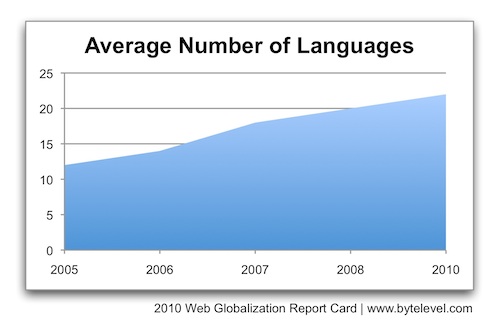
As you can see below, the number of languages that companies support has steadily grown over the years. In the 2010 Web Globalization Report Card — in which we tabulated the languages of 225 global web sites across 21 industries — the average was 22 languages.
I’m not suggesting that companies add languages for the sake of adding languages.
But I do suggest that companies conduct regular “audits” of their own language mix, the languages supported by the competition, and the languages supported by the ecosystem as a whole.
I’d prefer to be the first company within a given industry to support a new language than the last. Only by keeping a close eye on languages and the competition can you achieve this goal.
Consider Russian. Five years ago, fewer than 40% of the major global web sites supported this language. At that point in time, a company might not have felt any pressure to localize for Russia simply because few other companies did so. Today, seven out of 10 companies now support Russian, which means that companies that hope to do business in Russia and do not support Russian are now in the minority.
Now let’s look at three companies in more detail: NIVEA, Starbucks, and Genzyme.
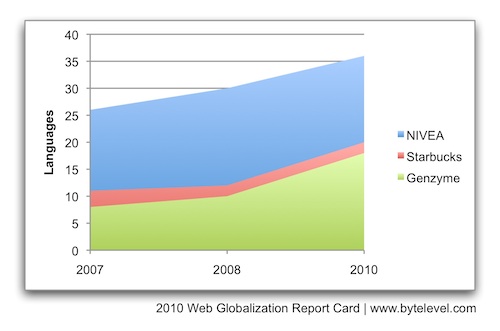
Each of these companies occupies a different industry sector and yet all three continue to add languages, each at its own pace.
For more information on language trends and much more, check out the 2010 Web Globalization Report Card.
I am not sure just having a lot of languages is meaningful in itself.
It would also depend on the company – if you have a product that could truly be sold to lots of people, all over the world who go to the web and use the info then it makes sense to have info in all those languages, and if you don’t have a customer base that cares then you could be truly global with just a handful of languages. Thus, the more important issue is what is important to your customers.
If you are Nivea it may be 35 and if you are Louise Vuitton it may be just 10 to reach the 90% of your customers who really care that you have content in their language.
I also question the value of the rankings of the top 25 — having Google produce a few pages in 125 languages, does it really make them more global? Do depth and real engagement not matter? The Google engine produces suspect results in a lot of those languages. In fact in the most active markets in Asia: China, Japan, Korea, Google is not the preferred search engine mostly, because they don’t do a very good job of searching content in the local language. So what does it really matter if they have a few pages in the local languages?
I think also it is very likely that as we get past the top 30 or 50 languages, mobile content starts to matter more and more. There are 1.7B people on the web but there are over 4.5B already with mobile access.
So maybe if you really want global coverage you should be thinking about how to get content out differently.
Check out http://www.jw.org the website is viewable in more than 230 languages!
Impressive!
Languages are just one of five metrics we used for the Report Card, so it alone does not determine if a company makes the top 25 list.
In fact, there are a number of companies that support more than 30 languages that did not make the top 25.
So, no, number of languages alone doesn’t make a site “global.” But you certainly can’t be global without them.
Like I said, languages are a means to an end.