
It’s not easy having an American English keyboard when you frequently need to input characters like è or ä or ç.
Or ¥. Or €.
Maybe it’s because I switch between Mac and Windows so frequently. Or maybe I’m just too lazy to remember the keyboard shortcuts.
Fortunately, I just discovered: CopyPasteCharacter.com.
Give it a shot and you’ll see [...]
Entries Tagged as 'Unicode'
How do you type € again?
November 21st, 2009 · 2 Comments
Tags: Unicode
Kindle goes international, but not multilingual
October 13th, 2009 · 2 Comments
The Kindle has gone international, sort of.
That is, Amazon is launching a new Kindle outfitted with a radio chip that works in most of the world’s cellular markets (100+) — as opposed to the US-only Kindle, which operates only on Sprint’s network.
Unfortunately, just because someone in, say, Russia will be able to download a book, [...]
Unicode (used creatively) makes your Tweets go further
August 20th, 2009 · 2 Comments
I’m not exactly a power-Tweeter, so I can’t say I have the need for a tool that stretches Twitter’s 140-character limit.
Still, I get a kick out of Maxitweet.
To understand what it does, here’s an example.
I entered the following text: 149 characters.
Call me Ishmael. Some years ago–never mind how long precisely–having little or no money in [...]
Type Russian without the keyboard
July 28th, 2009 · 2 Comments
There are shortcuts on most English keyboards for entering characters such as á and é.
But I can never seem to remember what those shortcuts are.
Fortunately, there is TypeIt, an online editor that gives you the ability to input non-ASCII characters used by languages such as Spanish, Hungarian, and Russian. Here’s a screen shot:
Operating systems like [...]
The Localization of iPhone
August 29th, 2007 · 2 Comments
So I gave in to my inner geek and purchased an iPhone.
One of the things I first noticed (and love) about the Web browser is the .com button on the keypad, shown here.
Of course, this little shortcut isn’t so handy if I want to visit a .org or .edu Web site.
It’s also not much use [...]
Tags: Apple · Arabic · Business globalization · China · Domain names · Unicode · Web Globalization
Microsoft Vista Upgrades to Unicode 5.0
December 26th, 2006 · No Comments
Microsoft has played a major role helping to establish Unicode as a global standard.
Microsoft first migrated to Unicode for its Windows 2000 operating system. In doing so, it cleared the way for faster development of global software. It also allows users to more easily share documents that includes multiple languages and scripts.
This Microsoft article [...]
Tags: Software Localization · Unicode
Unicode 5.0: The Book
November 1st, 2006 · 1 Comment
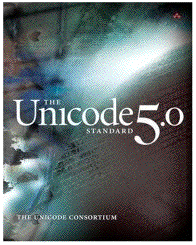
According to the press release, Unicode 5.0 is now in print and “available at booksellers everywhere.”
According to Amazon the book is still in pre-order stage. And I’m curious to know if Amazon is serious about the free shipping option — after all, this book weighs in at a whopping 1,400 pages!
Tags: Unicode · Web Globalization
Unicode Turns 5.0 Today
July 18th, 2006 · Comments Off
There was some mighty big news made today — mighty big if you’re a globalization geek — the fifth iteration of Unicode was officially launched.
Says the press release: “The Unicode Consortium announces the release of a significant update of its widely-used Unicode Character Database (UCD). The new version, Version 5.0, defines more than 99,000 characters [...]
Tags: Unicode · Web Globalization
An Inside Look at the Globalization of Windows
December 15th, 2005 · No Comments
Robert Scoble has taped an interesting interview with Michael Kaplan, who’s the technical lead in charge of the globalization of the upcoming Windows Vista OS.
If you’ve got a half hour to spare, it’s worth a watch. It gets a bit techie at times but there are some grest nuggets of wisdom for anyone involved in [...]
Tags: Software Localization · Unicode · Web Globalization
Unicode Is Really Getting Fashionable
September 11th, 2005 · Comments Off
Michael Kaplan called my attention the latest Unicode fashion accessory:
For those who don’t get it, that funny little question-mark character is what Mac users see when their computers don’t have the right font to display a given character (or if the Web browser gets a bit confused about what font to display). Just because Unicode [...]
Tags: Unicode · Web Globalization

