
TED is looking for a few good translators

For translation crowdsourcing to work, first you need crowds.

And TED, which has been using the crowd to provide translation of its videos, is looking for a few more participants. Here’s a recent blog posting:

Wanted: Translators
The goal of TED’s Open Translation Project is to bring ideas worth spreading to the wider world by offering TEDTalks with subtitles in as many languages as possible. Still, many of the world’s languages aren’t yet represented in the project, and we want to fill those gaps. Today, we’re putting out a call to translators worldwide to help us translate the languages that the project hasn’t yet covered.

We’re looking for translators who speak these languages, in particular:

  • Akan
  • Assamese
  • Filipino
  • Galician
  • Gujarati
  • Icelandic
  • Khmer
  • Maltese
  • Marathi
  • Mongolian
  • Nepali
  • Panjabi
  • Sinhala
  • Tagalog
  • Tibetan
  • Tswana
  • Yoruba
  • Zulu

In some cases, translations in the languages above have already been completed, but remain unpublished because they still need to be reviewed. (Some of the languages only have one translator.)

These languages aren’t exactly what the translation industry would call Tier 1. That is, there simply isn’t as deep pool of translators to draw from. Which is why any crowdsourcing strategy must take into account the size of the potential crowd.

So how is TED doing so far with its crowdsourcing project?

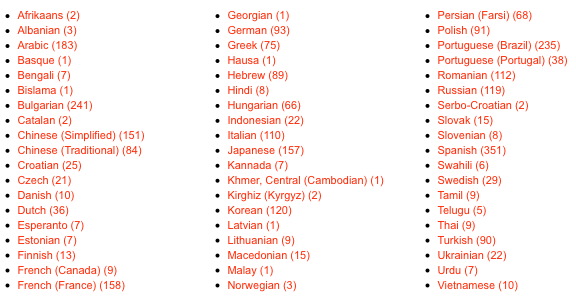
This menu should give you an idea of what languages are covered and to what extent. Chinese and Brazilian Portuguese are doing best by far.
ted_languages_content

For roughly six months of work, TED appears to be doing quite well.

Translation crowdsourcing is the new black — and you can tweet me on that

bird-translator

Was there any doubt that Twitter would not try to crowdsource its translations?

After Facebook proved that it could use volunteers to go from 1 to 100 languages in two years, it was just a matter of time before Twitter adopted the same model.

Twitter is starting out with the FIGS (French, Italian, German, and Spanish). And here is a video tutorial from Twitter that shows you how how the platform works.

Crowdsourcing is the new black these days, and much of it deserved. But despite the buzz, companies should be very careful before embracing the model.

Very few companies are translation-worthy

Wikipedia, Google, Facebook, TED, and Twitter have legions of fans who are happy to lend their translation skills. But few corporate sites or services are so translation worthy. And there’s the ever-constant risk of translator backlash or burnout. We are in uncharted territory, and as more companies pursue this model, we’re going to see more and more efforts backfire. Hey, maybe we’ll even see companies begin to “pay” their volunteers in non-monetary forms of compensation. Which leads me to…

Crowdsourcing may not save you much on translation

The translation platform, the management of the platform, the management of the volunteers — they all require resources. And the odds are that you’ll still want to retain professional translators to manage the amateurs, which is not a bad thing. There is a peace of mind in having a vendor who does this sort of thing for a living signing off on a newly localized web site before it goes live. In the end, translation crowdsourcing is not about saving money.

As far as I can tell, Twitter has only a thousand or so text strings that require translation. In the time the company devoted to building this translation platform, it could probably have had the site localized in 50 or more languages.

Over time there probably will be cost savings, but I would argue that cost savings should not be the motivator and probably wasn’t the motivator for Twitter.

The platform companies develop to support crowdsourcing should have other measures of success, such as user engagement and testing, partner opportunities, and developer involvement.

For example, on the Twitter Translate information page, this paragraph jumped out at me:

Will my favorite applications be translated, too?
We know that Twitter is not all about Twitter.com, so our global reach shouldn’t be limited to Twitter.com either. That’s why we’re planning to give our developer community access to the translation files so they can create wonderful apps that use the translations, too.

This is where Twitter is headed with the platform, as well as Facebook and Google. Once you have the platform, you can get creative with it — expand it to developers so that they can quickly localize their apps. You can even try to open up the platform for “partner” sites to use — which is what Facebook is now doing.

As companies comes to grips with social media, they are slowly learning to let go. Employees blog and tweet. Customers post content on corporate sites, and now they are co-creating the localized products.

The top-down localization model is giving way to the bottom-up model, and this is a profound change, even if it’s limited to a handful of companies — albeit companies that represent a few hundred million users. I’m still trying to understand how far this phenomenon will go.

TED is translation-worthy

icon_translator

Earlier this year, TED began recruiting volunteers to translate its recorded presentations, known as TED Talks.

It looks like the venture is off to a strong start. According to TED, more than 1,500 volunteer translators have provided more than 1,000 translations in more than 50 languages. And another 1,000 translations are in the works.

September 18, 2009 Update: TED has reached 2,000 translations.

Now, putting aside my concerns about a company getting services for free that it could very well afford, I want to focus on what TED has done well with its web site to facilitate the crowdsourcing of translations:

  • All translators have their own profile page (see below)
  • Translators get little buttons they can use to promote themselves (see above)
  • The translators who have done the most work are highlighted
  • The most-translated talks are highlight (see below)

ted_translator

One of the most active translators is Yasser Bahjatt. I like how you can click on the talks that he has translated.

A picky comment: Why is Arabic in Latin script? Wouldn’t it make more sense to use Arabic script? Details, I know, but these details count when you’re trying to create content for people who may not understand any English.

Next, here is a screen shot of the most popular talks — at least among translators:

ted_translator2

As TED adds more and more translated content, it’s going to need to devote resources to providing a fully localized user interface (UI).

Right now, TED offers this:

ted_gateway

But for the most part, the TED site expects users to know a fair amount of English if they’re going to navigate to their translated content.

Ultimately, TED will have to localize its Web site — or just the Ted Talks section — so that people can more easily find their translated content. And this I suspect won’t come free.

Nevertheless, TED has proven that its content is translation-worthy and it has done a great job of creating a community of translators who are bound to keep the effort alive and growing.

Why Pay for Translation if You Can Get it for Free?

It was nice to wake up this morning and see this article in the New York Times about the emergence of machine translation and volunteer translation (aka crowdsourcing). These are two very important developments that every companies needs to be aware of — and possibly champion.

That said, I do wonder how this article is going to be received by the translators of the world who actually expect to be paid for their services.

For example the for-profit, invite-only conference company TED saved about $500,000 using volunteer translators. Clearly TED could have coughed up the money.

I can see this article spurring on CEOs across the land to think that they too can get free translations.

One thing I mentioned awhile back is that you need to be translation-worthy to get away with pro-bono services, particularly if you’re a for-profit company.

Facebook, Google and, now, TED appear to be translation-worthy. But I wouldn’t expect to see, say, General Motors succeeding in this area (though they could certainly use the help).

But the larger issue here is to the extent that volunteer translation for companies that can afford to pay for translation undermines the translation industry. I don’t believe machine translation undermines human translation because companies generally use it to translation text they would never have hired people to do (or they use it as a first pass before bringing on the human translators).

But volunteer translation is different.

Are  volunteer translators taking money away from their colleagues? After all, TED and Google and Facebook certainly can afford to pay. Or are volunteer translators raising awareness for the value of their work, thereby benefiting the translation industry as a whole?

Personally, I think we’re entering a dangerous area where companies that don’t know better are going to think they don’t have to pay for translation. This all reminds me of Seinfeld‘s George Costanza’s aversion to parking garages: Why should I pay, when if I apply myself, maybe I could get it for free?