

In 2016, more than 120 million Chinese traveled internationally. which is roughly the entire population of Japan (or Canada, Italy and Australia combined).
And only 10% of the country has a passport.
Imagine the travel industry when 25% of Chinese residents are traveling abroad. Where will they go? What will they want to see? To help shed light on these questions, Hotels.com recently interviewed 3,000 Chinese residents who traveled internationally over the past year.
It published these findings in the 2017 edition of the Chinese International Travel Monitor report. If you want to better understand Chinese travelers, where they’re headed and why, this report is a must read.
Here are a few items that jumped out at me:
- China is already the largest source of international travelers for many countries.
- Yet only 10% of the Chinese population had passports in 2016.
- Shopping is no longer the prime attraction for a growing number of travelers
- Nor is group travel, which is quickly losing favor among older travelers. Translation: Chinese travelers are tiring of those buses.
- Independent travel is very popular among millennials.
- And eco/green tours are becoming quite popular, particularly among older travelers. I’m very happy to see this.
- The most welcoming countries to Chinese travelers, based on survey respondents, are Thailand, Japan, Australia. The USA made the top 5, though I suspect that ranking might be slipping based on current events.
- The top landmark in the US: Grand Canyon.
- The top landmark in Australia: Great Barrier Reef.
- And in France: the Louvre.
- Chinese visitors spend more in the US than visitors from any other nation, approximately $7,200.
So what does this mean for hotels and other travel segments? It means you have be curious, nimble, and you had better support Chinese — both on your website, in your call center, via social media, and with in-house Mandarin speakers. Survey respondents ranked poor hotel localization as a top 5 problem.
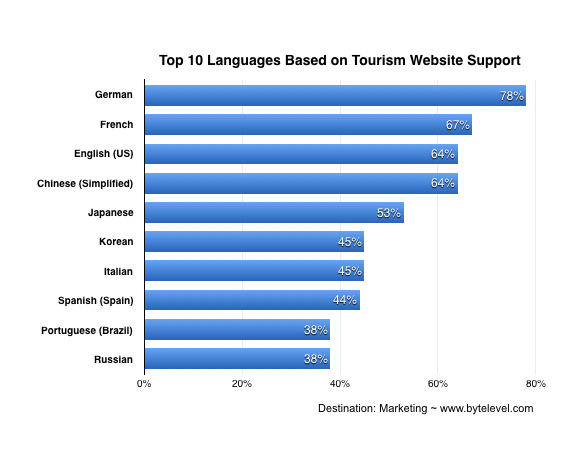
Chinese is also not as well supported across many of the global travel websites I reviewed two months ago. As shown here, based on our new report Destination: Marketing, Chinese is found on only 64% of the leading tourism websites.
Also, accepting Visa or Mastercard is not good enough. Most Chinese travelers prefer to pay with UnionPay.
Click here to download the report.
And if you’d like to know which tourism and destination websites are the most world-ready, check out our new report Destination: Marketing.
Finally, if you want insights into localizing your website for China, check out Think Outside the Country.