Global by Design turns 1,000

In 2002, I launched this blog.

It was the first blog devoted to web globalization. In fact, I don’t believe there were any blogs devoted to translation either at that point in time. So I really wasn’t sure where this whole blog thing would lead me. Perhaps I’d lose interest along the way.

Evidently, I didn’t, for today marks blog post #1,000.

I’m not the most prolific blogger to be sure (and I relied on a handful of guest articles along the way).

But it has been an exciting journey. I took a few minutes to page through the archives and I’ve included below a number of posts that jumped out at me (NOTE: a lot of the news links are broken):

In 2002, China had fewer than 100 million Internet users. Machine translation was more of a punchline than a business tool. And at the time you could count on one hand the number of web sites that supported 40 or more languages. Today, there are more than 23 such web sites.

I also took a stroll through Google Analytics. Though I didn’t have analytics in place during the early years, here are the three most popular blogs since 2005:

  1. Starbucks CEO on Globalization: Don’t Go Changing
  2. Google and the Global Traveler
  3. Google vs. Baidu: A User Experience Analysis

Thanks for reading over the years — and all your input and comments!

Google Translate App for iPhone: Will it hit number 1? (Answer: Yes!)

I’m a little amazed by all the press that the Google Translate app for iPhone is getting today.

From The Wall Street Journal to the LA Times, this app is getting noticed.

And this app doesn’t even include the “Conversation Mode” feature that is currently included in Google Translate for Android app. It will be interesting to see how quickly Conversation Mode makes it into the iPhone given Google’s escalating mobile battle with Apple.

I checked the iTunes store a moment ago to see that the app is ranked at #16 in the Free category. Not bad!

Now, can it beat the mighty Sky Burger app for the number one spot?

I think it can.

PS: The Google Translate app supports 30 or so languages, which means its one of the most-localized apps on the iPhone (if not THE most localized).

UPDATE: One day later and, yes, the Sky Burger app has been unseated by Google Translate!

Previewing the 2011 Web Globalization Report Card

I’ve begun work on the 7th edition of the Report Card. To produce this report I individually review more than 200 global web sites across more than 20 industries. Needless to say, I’ve got a busy month ahead!

I’ve already done a first pass on a number of web sites and have some initial thoughts to share:

  • As regular readers know, Google and Facebook finished in a dead heat for first place last year, with Google having a slight advantage. Both companies made significant changes over the past twelve months, changes that promise to make this another photo finish.
  • I’ve noticed an increase in the number of sites using geolocation for navigation. Unfortunately, some of these sites are not using geolocation as well as they should. As I’ve noted in my book, geolocation should never be used without a visual global gateway in place. Geolocation is an excellent tool, but it presents a number of edge cases that only a global gateway can solve.
  • I’ve seen some amazing global gateways so far, and, in some cases, demonstrating vast improvements over previous global gateways. I’ll be documenting a number of these gateways in the report.
  • Companies continue to add languages. After initial analysis, Indonesian is hot, as is Russian and Turkish. Last year, the average number of languages was 20. I suspect we’ll see increase again this year. Keep in mind that this is just the average. Companies like Cisco, Apple, and DHL are well above 20 languages.
  • For last year’s report, I began measuring “community localization” — the integration of social networking platforms into local web sites. I wasn’t just looking at Twitter and Facebook use around the world, but at how companies are fostering communities. I’ve noticed quite a lot of Facebook integration around the world. Below is a home page visual from Samsung Italy:
  • Samsung also promotes its Twitter feed on the home page of its Brazil site. And Samsung is far from alone.
  • Finally, I’m noticing lots and lots of web site surveys.They’re popping up everywhere and in many languages. Somebody please make them stop!

Here is the link to the 2010 Report Card. All companies included in this report will be included in 2011. We’ll have a page for the 2011 report up shortly.

Is Apple giving up on flags?

Apple has been using flags as part of its global gateway for many years.

In 2006, Apple’s global gateway was positioned in the footer and featured a different flag for each country web site:

Today, Apple has done away with the pull-down menu, but not the globe. Look to the right of the footer of Apple.com and you’ll see this:

But Apple recently moved away from using flags on its online store, perhaps a sign of things to come, shown below:

The flags have been replaced with plain text links.

I’m not saying that Apple is wrong for using flags. Apple does not make the mistake of using flags to indicate language. Flags are only used to indicate countries and regions.

But flags do not scale well.

Flags worked better when Apple supported fewer than 20 localized site. But Apple is clearly in scale mode, adding stores in countries around the world. Plain text links add less overhead (in bytes) than images and, more important, are easier for people to scan than a blur of flags that mostly share the same basic colors.

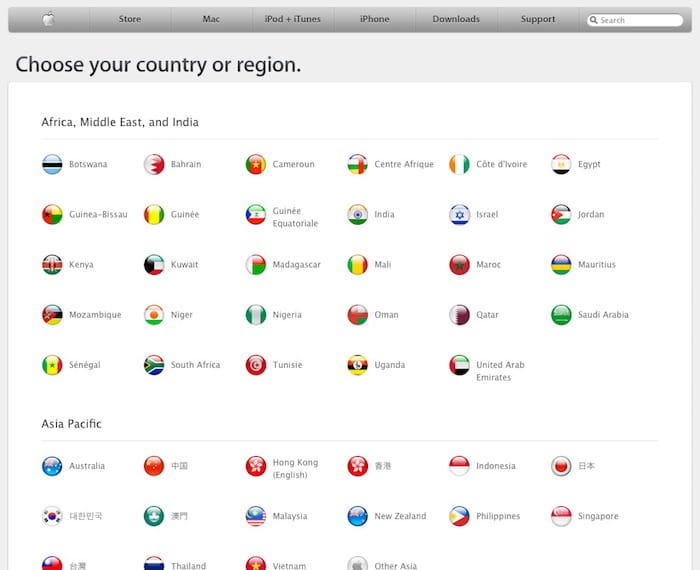
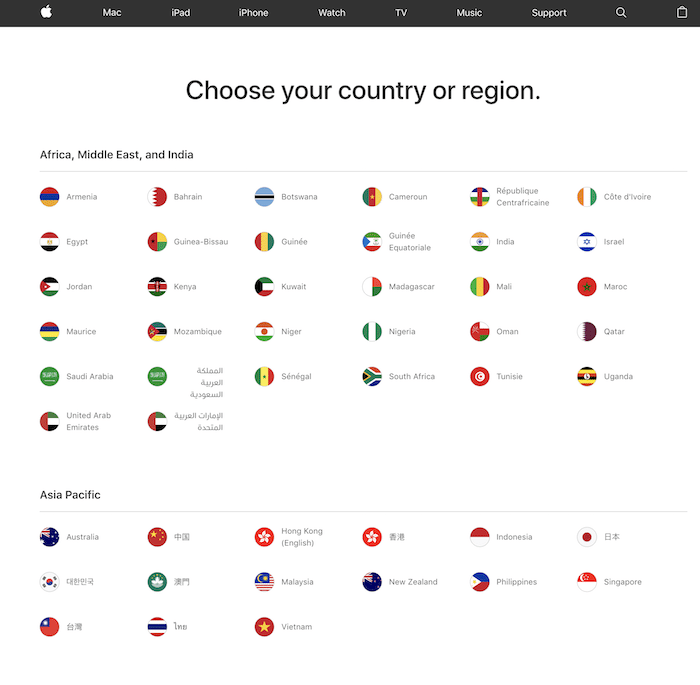
Consider the page below, also from Apple. I don’t believe this sea of colors amounts to any sort of usability gain. In fact, if you look closely you’ll see some faux flags created for “Other Asia” and “Latin America.”

I don’t hate flags. Really, I don’t.

But as I write in The Art of the Global Gateway, flags have many inherent limitations — from geopolitical to practical. And because flags do not scale well I think that Apple will eventually (largely) give them up.